
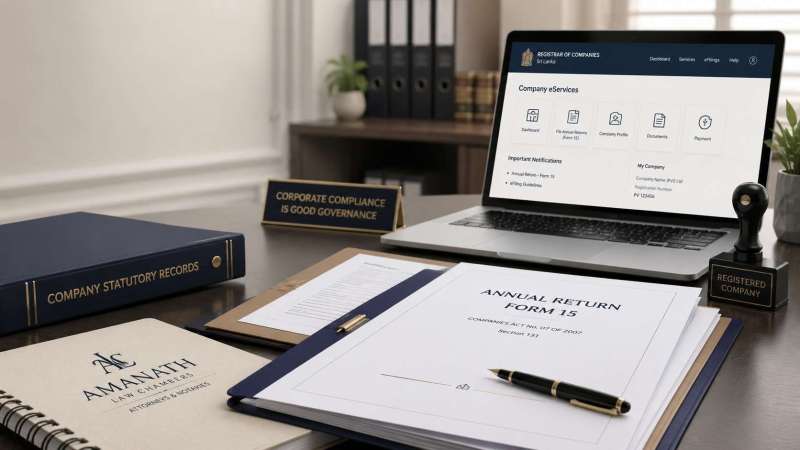
Running a company involves more than incorporating it and carrying on business. Once a company is registered, there are ongoing statutory obligations that must be complied with, including the filing of its Annual Return with the Registrar of Companies (ROC).
For many company owners, terms such as “Annual Return” and “Form 15” can be confusing. Is an Annual Return a financial statement? When does it have to be filed? What information needs to be included? And what happens if the company cannot hold its Annual General Meeting (AGM)?
This article explains the Annual Return and Form 15 requirements for companies in Sri Lanka in simple terms.
What is an Annual Return?
An Annual Return is a yearly statutory return submitted by a company to the Registrar of Companies.
It is important to understand that an Annual Return is not the same as a financial statement. Rather, it provides the ROC with an updated picture of the company and its affairs.
Among other things, the Annual Return contains information relating to matters such as:
- The registered office of the company;
- The directors and other relevant officers;
- The shareholders and shareholding;
- The shares issued by the company;
- The auditors; and
- Other prescribed information relating to the company.
The Annual Return also reflects relevant changes that have taken place during the relevant period.
In simple terms, the Annual Return allows the ROC to keep the company’s statutory records up to date.
Is filing an Annual Return mandatory?
Yes.
Companies incorporated under the Companies Act No. 07 of 2007 are subject to continuing statutory filing requirements, including the requirement to submit an Annual Return to the Registrar of Companies.
Failure to comply with these requirements can result in penalties and may also cause difficulties when the company needs to obtain certificates, update its records or carry out other transactions with the ROC.
For this reason, Annual Return compliance should be treated as an important part of the company’s regular corporate compliance.
What is Form 15?
Form 15 is the prescribed form used for submitting the company’s Annual Return to the Registrar of Companies.
The Annual Return contains information about the company, while Form 15 is the statutory return through which that information is submitted to the ROC.
The information required may include details concerning the company’s:
- Registered office;
- Directors;
- Shareholders;
- Share capital and shares;
- Auditor; and
- Other prescribed corporate information.
It is therefore important for the company secretary and directors to ensure that the information submitted in the Annual Return is accurate and consistent with the company’s statutory records.
When does a company have to file its Annual Return?
The first Annual General Meeting of a company must generally be held within the period prescribed by the Companies Act, and the Annual Return is subsequently filed in connection with the company’s AGM.
After the first AGM, the company must continue to hold an AGM each year, subject to the requirements and exceptions provided under the Companies Act.
The Annual Return must be delivered to the Registrar within the prescribed period following the AGM.
Therefore, companies should not wait until the last minute to prepare Form 15. The company’s statutory records should be reviewed in advance so that any necessary changes or updates can be properly reflected.
The connection between the AGM and the Annual Return
The Annual Return process is closely connected to the company’s Annual General Meeting.
In general, the process can be understood in two stages:
Step 1 – Hold the Annual General Meeting
The AGM provides an opportunity for the shareholders to consider the company’s affairs and deal with matters required under the Companies Act and the company’s Articles of Association.
Depending on the company and the matters arising for consideration, these may include matters such as:
- Consideration of the company’s financial statements and reports;
- Appointment or reappointment of directors;
- Appointment or reappointment of auditors;
- Declaration of dividends, where applicable; and
- Other matters requiring shareholder consideration or approval.
The directors are responsible for ensuring that the AGM is properly convened and conducted in accordance with the law and the company’s Articles.
Step 2 – Prepare and file the Annual Return
After the AGM, the company’s Annual Return must be prepared with the relevant information and submitted to the Registrar within the prescribed statutory period.
The company secretary plays an important role in ensuring that the Annual Return is correctly prepared and filed.
What if the company cannot hold an AGM?
There are circumstances in which a company may deal with matters that would otherwise have been considered at an AGM through the written resolution procedure permitted under the Companies Act.
Where this procedure is applicable, the necessary shareholder resolutions must be properly prepared and executed in accordance with the statutory requirements.
The relevant resolutions and supporting documents may then need to be submitted to the ROC together with the Annual Return.
However, companies should not simply assume that an AGM can be replaced by a resolution in every circumstance. The requirements of the Companies Act and the company’s Articles should be checked before relying on this procedure.
How is Form 15 filed?
The ROC has moved its company filing processes to an electronic system through the eROC platform.
The process generally involves the following steps:
- eROC account access
The relevant director or company secretary must have the required user access to the eROC system.
Where necessary, the company must also be properly connected to the relevant user account.
- Prepare the Annual Return online
The company secretary or authorised director can access the relevant company records through eROC and enter or update the information required for the Annual Return.
The information should be carefully checked against the company’s statutory records before submission.
- Generate and sign Form 15
Once the Annual Return has been completed, the eROC system generates the relevant Form 15.
The form should be downloaded and signed by the persons required under the applicable ROC procedure.
- Upload and make payment
The signed document is uploaded through the eROC system and the applicable statutory filing fees are paid online.
The filing process is completed once the ROC requirements have been satisfied.
Why is timely filing important?
Annual Return filing is not merely an administrative formality.
Keeping the company’s ROC records up to date is important for maintaining good corporate standing and ensuring that the company’s public records accurately reflect its current position.
Delays or omissions can create problems when a company later needs to:
- Make changes to its directors or shareholders;
- Update corporate information;
- Obtain documents or certificates from the ROC;
- Deal with banks and financial institutions;
- Enter into transactions requiring corporate due diligence; or
- Complete other regulatory or corporate compliance requirements.
A company should therefore maintain a compliance calendar and monitor its AGM and Annual Return deadlines each year.
Final thoughts
In simple terms, the Annual Return is the company’s yearly statutory update to the Registrar of Companies, while Form 15 is the prescribed return used to submit that information.